
The Baptists on Baxter
Whether Baxter was considered a Christian by the Baptists?

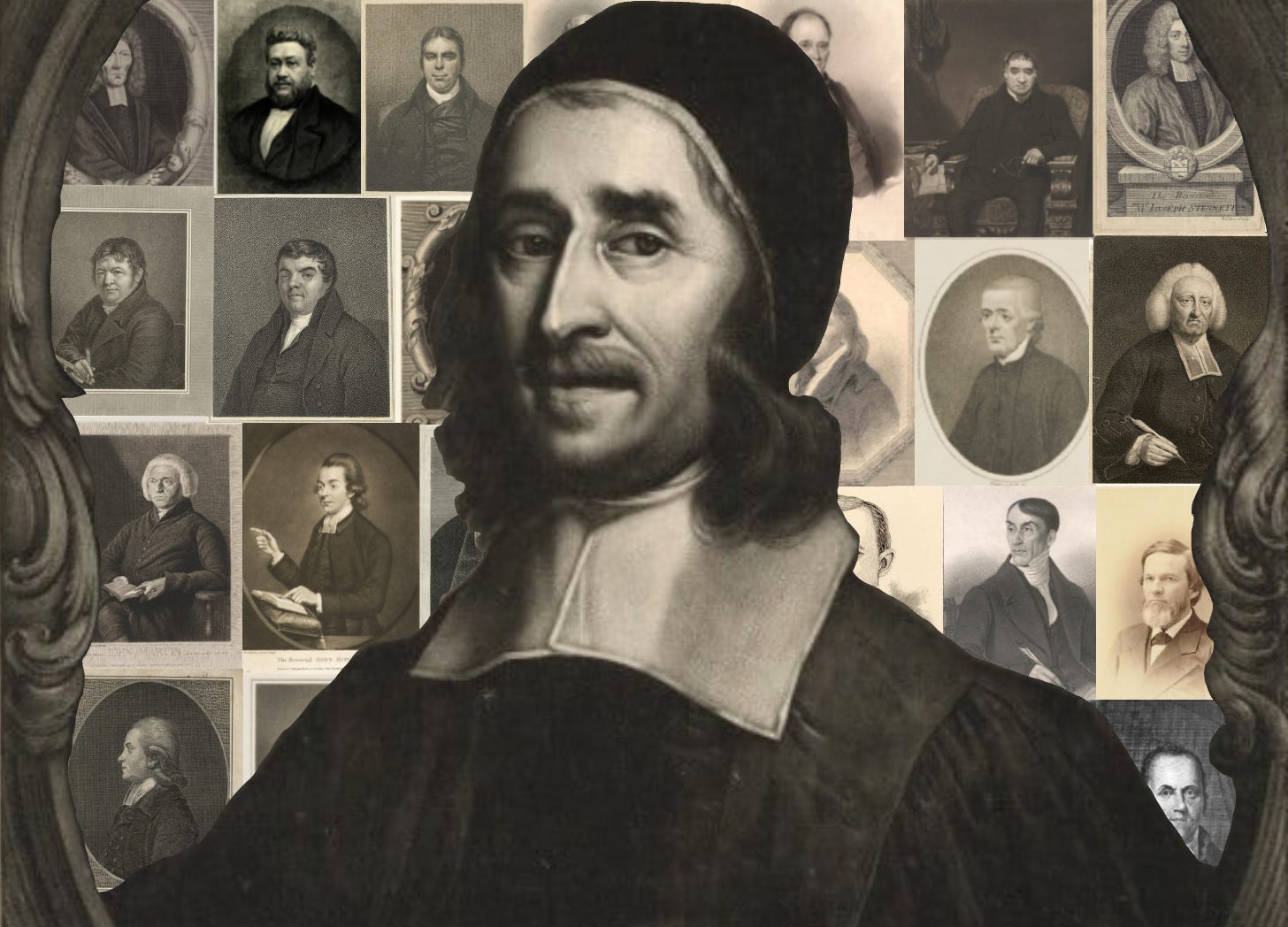
Contents.
Preface
I write this article on account of the immense and vitriolic abhorrence of contemporary Reformed Baptists towards saintly old Richard Baxter. I shall not presume to include any biographical information concerning him; it is unnecessary. It is needless to say, that the hatred surrounding Baxter arises from his not uncontroversial doctrines concerning that all-important locus of justification. I shall not comment on whether, or where he erred; such is not the purpose of this piece. Nor do I intend to name those I find guilty of hating too much the famous puritan. I shall simply document, with some few passing comments, historic Baptist—principally Particular Baptist—attitudes towards Baxter. I by no means intend to argue herein, that his doctrine of justification was received with approbation, by Particular Baptists; nor, that his doctrinal works ought to be read; but simply, that Baxter was considered, by most—so far as I can tell—a Christian. Nor is this intended to be completely comprehensive; there certainly is more which I could have included. I shall undertake this in a mostly chronological order. I shall on occasion abridge (though not paraphrase) the quotes somewhat, including only the necessary context. The spelling, but not phrasing or grammar of texts, shall be modernised. I have included less of moderns, not for contempt of them, but for the relative difficulty in acquiring their works; I grant that our learned Dr James Renihan, amongst others, might well differ from me on the issue—I have read his treatment, as well as others. Whilst I by no means wish to stir controversy, yet I consider the continual disdain poured upon Baxter worthy of treatment.
My intent, then, is to answer the question, ‘Whether Baxter was considered a Christian by the Baptists?’ Reader, you may be the judge as to whether I succeed.
God bless.
Particular Baptists
§1. Thomas Ewens
Ewens (or Ewins) was a co-minister at the Broadmead Baptist church in Bristol, with Robert Purnell. The church, in the early years of his ministry there, was open-membership. He had first belonged to Henry Jessey’s church, and was baptised in London in the year 1654. He ministered at Broadmead until his death in 1670, having accepted the call in 1651.1
But thirdly, for that godly man Mr Baxter, whose face I never saw, yet do I highly honour and esteem for some of his works, and for what good I hear of him, yet I see no ground why I should so understand Mr Baxter, or the other two, as this man seems to force their meaning[.]
—Thomas Ewens, The Church of Christ in Bristol Recovering Her Vail Out of the Hands of Them That Have Smitten and Wounded Her, and Taken It Away (London: Thomas Brewster, 1657), 65.
Some few lines later, he refers to Baxter as ‘godly Mr Baxter’; he says that, if Baxter did herein err (namely, with respect to whether ‘the pretence of preaching by the Spirit is but a pious fraud, to set up ourselves in the hearts and consciences, and consequently in the purses of people, etc.’; p. 66-67), yet he knows ‘there are many others of like eminency, both for learning and godliness, that are of another mind in this particular’.2 This ought prove that he considered Baxter as of considerable eminence, both for learning and godliness. Note, that the two other persons quoted against Ewens, are John Owen (the most famous of the Congregationalists), and Henry Lawrence (who was a baptistic congregationalist; I shall publish more on him in other articles, Lord willing—he having been the subject of much of my studies).
§2. Edward Hutchinson
Hutchinson was a leading Particular Baptist in his day, and afterward. He wrote against Baxter, Baxter responding to a private letter with a book somewhat larger (namely, Review of the State of Christian Infants; the letter a few pages, Baxter’s book some nearly fifty). Thomas Delaune includes the letter in its entirety, verbatim, in his Truth Defended.
I can say (and I know that it is the mind of many) that what of Christ, and his Gospel, is visible in you, we highly prize and esteem; and your works, as far as they tend to advance true piety, we duly value[.]
—Edward Hutchinson quoted in Thomas Delaune, Truth Defended (1677), ‘Mr. Baxters Review of the state of Christians Infants Examined, &c.’, 2.
§3. Thomas Delaune
Thomas Delaune was one of the most well-known Particular Baptists of the 17th century; he was closely acquainted, it seems, with Benjamin Keach, as well as Edward Hutchinson. It seems, from his books, that besides his general learning (which was universally acknowledged as great), he was steeped in the contemporary literature produced by Baptists. He ministered principally in Ireland, but died a prisoner in England.
In the judgement of some it may perhaps add to the credit of that fancy that so famous a man as Mr Baxter is, should patronise it. But he is not the first theological grandee that has been mistaken. Performances of never so exalted a kind confer not the privilege of infallible. ‘Tis only the great Creator is unerring. A man may preach and write of the most seraphic verities, and yet know but in part; Mr Baxter is to be honoured as far as he has laid himself out to preach the gospel, and improve his talent for the conversion of souls in this evil day; but when he forgets himself, and instead of promoting practical holiness, fills the nation with notions as uncertain as they are numberless, puzzling such as arrive not to the subtilty of his distinction, creating more doubts than ever he’ll be able to resolve, making Christianity a mere riddle which no man understands but he, and liable to as many forms of interpretation as his wavering mind: then I humbly conceive he may be very safely left.
—Thomas Delaune, ‘To the Reader’, in A Treatise Concerning the Covenant and Baptism Dialogue-Wise, by Edward Hutchinson (London: Francis Smith, 1676).
§4. Benjamin Keach
I need not comment on the fame and importance of holy Keach. I do not intend to comment at large on those passages in his writings brought forth by those who consider Baxter an infidel, but mainly to comment positively, as to why it seems that Keach answered the question posed in the affirmative, or at least, not so confidently in the negative. Firstly, I think it ought to be noted that Keach, with bold frequency, in his book on the abrogation of the Jewish Sabbath, cites and quotes Baxter positively. He is so bold as to say, ‘Read Mr Baxter on the subject.’ Now, I ask the reader: do you recommend your readers to read infidels concerning such doctrines as that of the Lord’s Day? I must say, I never yet (that I recall) have heard from Calvin, ‘Read Mr Socinius on the subject.’ Or from Owen, ‘Read Mr Biddle on the subject.’ Or from Gill or Fuller, ‘Read Mr Priestly on the subject.’ This to say, we tend not, and ought not, to promote heretics in any wise, at least concerning doctrine. I grant that in this individual instance, Keach had probably a more narrow intent. But read the book, and you shall see that pages often find Baxter’s name upon them, and that, positively. I am therefore quite inclined to say, that whilst Keach thought Baxter’s doctrine to be dangerous, so much as to shake a foundation of the faith; yet never would he dogmatically declare, That Richard Baxter is no Christian. He says, indeed, in his exposition of parables: ‘I hope he was a good man’, so that it is no impossibility; and he follows it, ‘God might open his eyes before he died.’3 This might intimate that Keach thought, that as he was, Baxter’s soul was in danger—perhaps so! I do not think this overturns my thesis, and have little more to say regarding this particular passage.
There is an oft quoted passage:
I cannot see but that the doctrine some men strive to promote, is but little better than popery in a new dress.
—Benjamin Keach, The Marrow of True Justification (London, 1692), 17.
But the sentence immediately preceding seems to intimate the affirmative of the question proposed:
I am afraid many good Christians are not sensible of the sad danger they are in.
—Ibid.
Such, I think, intimates, that if in the latter Baxter is intended, so too he probably is in the former; but he is intended by the latter, therefore in the former. But this would then say that though Baxter is ‘not sensible of the danger’ he is in, yet he is a ‘good Christian’! I shall labour no further about worthy Keach.
§5. Joseph Stennett
Stennett was a seventh-day Baptist of the Calvinistic sort; he and his family were well-known and well-esteemed to the orthodox Particular Baptists of their day. This response to Russen was somewhat hailed, though he was known more for his hymns. As I understand this passage, he is referring to Baxter.
And as for those severe reflections which he produces from a book of Mr Baxter’s; since that pious man lived to atone for those hard censures, by giving them a character more suitable to them, and more becoming him, and that on diverse occasions both public and private; I am well enough pleased, that I have no need to repeat them, in order to take off their edge by a particular answer.
—Joseph Stennett, An Answer to Mr. David Russen’s Book (London: D. Brown, 1704), 234.
§6. Caleb Evans
Caleb Evans was president of the Bristol Education Society and an industrious, well-known teacher at the Bristol Baptist College (as it now is known). His father, Hugh Evans, was by birth and tongue a Welshman, of little less fame amongst the 18th century Particular Baptists.
Mr Baxter, sir, was a very great, and, I firmly believe, a very good man.
—Caleb Evans, A Reply to the Rev. Mr. Fletcher’s Vindication of Mr. Wesley’s Calm Address to Our American Colonies (Bristol: W. Pine, 1776), 74.
§7. William Staughton and the Philadelphia Association
This quotation is taken out of the circular letter of the Philadelphia Baptist Association, ‘held at Philadelphia, October 7th, 8th, 9th, 1800.’4
A careful investigation of the work of grace on the heart, will enable each of you to say before Jehovah, with a great divine of the last century [footnote: ‘Richard Baxter’], [etc.]
[…]
Signed in behalf of the whole,
Samuel Jones, Moderator.
Peter Wilson, Clerk.
—William Staughton, ‘Circular Letter on the Divine Origin of the Gospel, by the Rev. W. Staughton’, in The Minutes of the Philadelphia Baptist Association, From A.D. 1707, to A.D. 1807, ed. A.D. Gillette (Philadelphia: American Baptist Publication Society, 1851), 354-355.
§8. William Steadman, with John Rippon, John Ryland Jun., and Samuel Pearce
As an illustration of this remark, I would beg leave to recommend a paragraph transcribed from the great Mr Baxter, at the end of Dr Ryland and Mr Pearce’s sermon, at Mr Belcher’s ordination, just published, and sold by Mr Button, London; which I would be glad if you would insert in the register.
In compliance with the desire of Mr Steadman, the extract is most chearfully admitted[.]
—John Rippon, The Baptist Annual Register, ed. John Rippon (London: Dilly, Button, etc.; 1797), 2:462.
The said ‘Mr Belcher’ is Joseph Belcher, who later edited and published Andrew Fuller’s Complete Works, in three volumes.
§9. Titus Lewis
Titus Lewis of Cilgerran was a foremost Welsh Particular Baptist; known for his preaching, catechism (Holwyddoreg), and translations (mostly of Keach and Gill).
Owen, Manton, Bates, Vavasor Powel, Baxter, Jessey, Caryl, Goodwin, Flavel, a lluoedd ereill o’r dynion mwyaf a feddai y deyrnas, ïe, a feddai yr holl fyd[.]
—Titus Lewis, Hanes Wladol a Chrefyddol Prydain Fawr (Caerfyrddin: J. Evans, 1810), 454.
In English,
Owen, Manton, Bates, Vavasor Powell, Baxter, Jessey, Caryl, Goodwin, Flavel, and hosts of others of the greatest men which the realm has had, yea, the whole world has had.
—Titus Lewis, The National and Religious History of Great Britain (Carmarthen: J. Evans, 1810), 454. Translation my own.
§10. Francis Wayland
Wayland was a principal Baptist of the 19th century in America; perhaps his most significant comment, relevant to our current investigation, is an advertisement to Baxter’s Saint’s Rest, which is as follows:
I am gratified to perceive that you have published a handsome edition of Baxter’s Saints Rest. Of the value of the work itself it is superfluous to speak. It has few equals in any language. The ordinary copies are most palpably beneath the value of the work.
Such can be found appended to a great many works, as, for instance, his own The Elements of Moral Science, 3rd ed. (Boston: Gould, Kendall, and Lincoln; 1837).
We are told in his biography,
It should be added that the books which bore the marks of most frequent perusal were his Greek Testament, Baxter’s Saints’ Rest, Wilson’s Sacra Privata, and Leighton’s commentaries.
—Francis Wayland Jun. and H.L. Wayland, A Memoir of the Life and Labors of Francis Wayland, D.D., LL.D., Late President of Brown University (New York: Sheldon and Company, 1867), 1:408.
§11. Charles Haddon Spurgeon
I needn’t comment on the man.
Dissenting as I do from many of the opinions of that great man of God, Mr. Richard Baxter, I cannot but consider him to be the model minister of Christ. As a preacher he had such earnestness that he has been styled the English Demosthenes. Better still, he knew so well the terrors of the Lord that scarcely could Paul himself have persuaded men with greater earnestness than did Baxter. He knew what it was to have his knees knocking together while he preached to sinners of the wrath to come. Seldom did he go from his pulpit satisfied with his performances, but went to his knees to weep and bewail himself because he had not been more earnest with the souls of men. I do not marvel, however, at his earnestness in the pulpit, but what has made me consider him to be the very prince of preachers is the fact that he was equally earnest in the pastorate. Every house in Kidderminster was visited by Richard Baxter. There was not a child in the parish whom he had not catechised; there was not a backslider whom he had not warned; there was not a reprobate whom he had not addressed with solemn awe. The whole parish knew that Baxter considered himself to be the father of the flock. He did not only play the preacher in the pulpit, but the pastor in the parish. Now I scarce know by what stress of circumstances the minister’s work in London has become divided. I say honestly from my inmost soul, I do not conceive myself to be guilty of any dereliction of duty in the fact that I do take only one part of Baxter's work. It is utterly impossible that I should take the other. If I can preach twice in the day here, and there, and everywhere, as an evangelist, and if I can say that I exhaust myself and can do no more, I think I cannot plead guilty if another part of the office is left to others. Throughout London the pastorate, especially among the Dissenting churches, has to be left to you, the city missionaries. You take not Baxter’s place in the pulpit, but you take his place in the houses. I hold him up to you as the very mirror and pattern of a missionary, from house to house instructing, in the streets exhorting, under each roof teaching, personally labouring for the souls of men. But mark, if you were to ask for Baxter's plans of visitation you might when you read them over think them extremely ordinary, and having but little force in them. The power of Baxter lay, not in his method, but in his earnestness. There was such a fire in him that it all but consumed his bones. He was so passionate for the conversion of men that he was seldom in good health, and like a sword too sharp for its scabbard, his soul cut its way out of his body, and he died full of disease and pain. He would have done nothing, he would have been of no service to the church as Richard Baxter, if it had not been for Richard Baxter's earnestness. His divinity might have been worthless; his preaching might have been a delusion; his visitation an imposture, if it had not been that his soul
—C.H. Spurgeon, Speeches by C.H. Spurgeon, At Home and Abroad, ed. G. Holden Pike (London: Passmore & Alabaster, 1878), 26-27.
We wish we could preach to you with Baxter’s tearful eye; nay, rather, with the Saviour’s melting heart and all-consuming zeal.
—C.H. Spurgeon, Preaching Christ Crucified.
My spirit pants to have the consuming zeal of Baxter, and the earnest, passionate enthusiasm of Whitefield; but I cannot get it, except through your prayers; or getting it, it cannot be maintained without your vehement cries and entreaties before the Lord.
—C.H. Spurgeon, Warning and Encouragement.
I would fain go down these stairs, and talk to you one by one, but I might fail even with such an expedient as that, and there are far too many of you for me to come round to each one; yet I remember how holy Richard Baxter pleaded with his people, ‘I would fain come, and kneel down before you, one by one, and say to you, “Why will you reject the Saviour? Why will you die? Why will you cast away your souls?”’
—C.H. Spurgeon, An All-Important Question.
Look at Richard Baxter, in Kidderminster, what a flashing diamond was he! He had some spots, no doubt; but his brightness was most surprising; even swearers on the ale-bench could not but know that he was a heaven-born spirit.
—C.H. Spurgeon, God’s Jewels.
We Dissenters are sometimes charged with inventing a new gospel. We deny it. We say that our Owen, Howe, Henry, Charnock, Bunyan, Baxter, or Janeway, and all that galaxy of stars of the pulpit, did not pretend to say anything new; they only revived the things that Christ said, they only professed to be confirmers of the Witness. So has it been with the great men we have lost during the last century. Whitefield and his brother evangelists, and men who stood in the same position as Grill, or Booth, or Rippon, or Carey, or Ryland, or some of those who have just been taken away, — they did not pretend to say anything new. They only said, ‘Brethren, we come to tell you the same old story; we are not testifiers of new things; we are only confirmers of the Witness, Christ Jesus.’
—C.H. Spurgeon, Confirming the Witness of Christ.
We want a Baxter to bring men to immediate decision, — Baxter with weeping eyes and burning heart, — Baxter, who says, “I will go down on my knees to entreat you to think upon eternal things;” Baxter, who cries and groans for men till they cry and groan for themselves. Why will ye die? Why will ye lee that fatal procrastination kill you? Wherefore will ye put off seeking the Saviour until your day is over? Why will ye still waste the candle which is so short? Why will ye let the day go when the sun dips already beneath the horizon?
—C.H. Spurgeon, John Mark; or Haste in Religion.
I remember that Mr. Baxter said that he was not in a hurry to be gone to heaven; and a friend called upon Dr. John Owen, who had been writing about the glory of Christ, and asked him what he thought of going to heaven. That great divine replied, ‘I am longing to be there.’ ‘Why,’ said the other, ‘I have just spoken to holy Mr. Baxter, and he says that he would prefer to be here, since he thinks that he can be more useful on earth.’ ‘Oh!’ said Dr. Owen, ‘my brother Baxter is always full of practical godliness, but for all that I cannot say that I am at all desirous to linger in this mortal state. I would rather be gone.’ Each of these men seems to me to have been the half of Paul. Paul was made up of the two, for he was desirous to depart, but he was willing to remain because it was needful for the people.
—C.H. Spurgeon, The Dying Thief in a New Light.
I owe a great deal of my being brought to Christ to my parents, to whom I would always be grateful for their spiritual care of me; and as a parent, I am to repay that obligation by teaching my own children. I owe very much to a very excellent teacher in a day school. I did try, when I personally taught children, to pay back my teacher by teaching others. I owed still more to such men as Baxter and Bunyan, who left their books for me to read.
—C.H. Spurgeon, Cheer for the Worker, and Hope for London.
Diminish your ideas of the wrath of God and the terrors of hell, and in that proportion you will diminish the results of your work. I could not conceive a Bunyan or a Baxter, or any other great soul-winner, falling into these new notions, or if he did there would be an end to his success.
—C.H. Spurgeon, Conversions Desired.
Some of us would fain preach the gospel as simply, as earnestly, and with as seraphic a zeal as Bunyan, Baxter, or Brooks.
—C.H. Spurgeon, Girding on the Harness.
Brethren, it is a very healthy thing for us who are ministers to read a biography like that of M‘Cheyne. Read that through, if you are a minister, and it will burst many of your wind-bags. You will find yourselves collapse most terribly. Take the life of Brainerd amongst the Indians, or of Baxter in our own land. Think of the holiness of George Herbert, the devoutness of Fletcher, or the zeal of Whitfield. Where do you find yourself after reading their lives? Might you not peep about to find a hiding-place for your insignificance?
—C.H. Spurgeon, Onward.
I wish I had the strength, this morning, mental and physical combined, to urge this upon you as I have striven to urge it upon myself. I have sought before the Lord that he would teach me to live an active, earnest, laborious, heavenly life. Very few of us understand what life is. Baxter at Kidderminster, from morning to night spending and being spent for the Master’s service: Whitfield, all over England and America, toiling and labouring without the thought of rest, instant in season and out of season: these are the men we should emulate. But, alas! we do a little, and then we fold our hands, with ridiculous self-satisfaction.
—C.H. Spurgeon, Sermons from Saintly Death Beds.
O for something of Mr. Baxter’s spirit to make us love the souls of men as he did!
—C.H. Spurgeon, Withholding Corn.
I would to God I could preach as Baxter did. That man, the victim of many diseases, but sane and healthy in his mind, said he never came to his pulpit without tears and his knees knocking together, for he had to speak for God with men who must soon appear before his bar, and he himself must appear there too, to give an account of his preaching to them.
—C.H. Spurgeon, The Smoke of their Torments.
Men like Baxter with bursting hearts of love, or Joseph Alleine with glowing tongue, or Whitfield with seraph’s fire, or Wesley with cherub’s zeal; these are the men who bless their age and are most truly great. These men can go to the borders of the earth if they will; their commission is co-extensive -ex tensive with the human race—’Go ye into all the world, and preach the gospel to every creature’; ‘Lo, I am with you always, even unto the ends of the world.’ These men are never so happy as when they are preaching.
—C.H. Spurgeon, The Bridgeless Gulf.
I turn to Richard Baxter, a man who above all other men loved the souls of men; who more perhaps than any man, with the exception of the apostle Paul, travailed in birth for souls; and I find him making a barbed arrow out of the doctrine of the coming of the Lord, and thrusting this great truth into the very heart and conscience of unbelievers, as though it were heaven’s own sword.
—C.H. Spurgeon, The First Resurrection.
I am prepared to go about as far as my predecessor, Dr. Gill, went; as far as the old fathers of the Church went; as far as Baxter and Bunyan would have gone, but to go no further than that.
—C.H. Spurgeon, The First Resurrection.
Baxter’s ‘Reformed Pastor’ stirs my very soul whenever I read its glowing periods, — those fiery thunderbolts which he hurls at the heads of idle shepherds and lazy ministers. I have read nearly the whole book through to those who are studying for the ministry in connection with this church, and often have I seen the tears start from their eyes while listening to the burning language of that fervent preacher and writer. Every time I have read a chapter in that book, I have felt that, the next Sabbath, I could preach — I must preach — with greater earnestness after reading the solemn words of that mightiest of ministers, Richard Baxter. Ah, beloved, we need to have more of that earnestness in the pulpit!
—C.H. Spurgeon, Lukewarmness.
Baxter might write a Saint’s Rest, but I am no Baxter—would God I were!
—C.H. Spurgeon, The Feast of the Lord.
The imitation of Baxter is detestable; but to be like Baxter is seraphic.
—C.H. Spurgeon, An All-Round Ministry, Chap. 6.
Mr. Baxter lived through the most stirring period of English history. He was under the rule of Charles I., Cromwell, Charles II., and James II. He preached the gospel with his whole soul, protested against the vices of the cavaliers, and equally denounced the unconstitutional acts of Cromwell, and of the wretched monarchs who succeeded to his glorious throne. Richard Baxter was a moderate man in all but his zeal for God; hence he had a clear conscience, though he was always being blamed by some one or other. He was too good and great a man to narrow his mind to one party; he followed truth wherever he thought he saw her footprints; and, though we judge him to have been in some points mistaken, his errors are the unavoidable mistakes of one who laboured to be right. A clergyman has written this life — a good sign. Of course, the writer makes apologies, where he can, for his church, and begs that the Episcopalians of the present day be not accused of the sins of men so many generations back. This is most natural and justifiable; but we cannot forget that the very fountain and well-head of persecution is the principle and the existence of an established church. Uniformity logically follows establishment, and with it the punishment, or, at the very least, the toleration of those who refuse to con form. Baxter was a very harmless Nonconformist, for in fact he preached in his own house, and then went with his hearers to the parish church, until the rector brought him before the magistrates for daring to preach at all.
—C.H. Spurgeon, ed., ‘Notices of Books’, The Sword and the Trowel, August 1888: 440.
§12. Godfrey Holden Pike
Pike was sub-editor of Spurgeon’s Sword and the Trowel; he wrote a multiple volume biography of him, and edited and published some of his speeches posthumously (above quoted).5
Noble Baxter! When compared with you, and with other like stars of the seventeenth century galaxy, what diminutive tapers are the majority of us? And how contemptibly poor and abject do they appear who have lived merely for earthly wealth and for earthly honour? ‘Almost well’, he replied, when at his death one asked him, ‘How are you?’ We take our leave of him at Charterhouse-square, unless, indeed, we feel disposed to follow his lifeless clay to its sepulchre in Christchurch, where it rests beside the coffin of his beloved Margaret. Noble Baxter! How plainly manifest is it to you now that, notwithstanding all its painful privations, your lot on earth was a blessed lot. We admiringly contemplate your work, but cannot describe your reward. To do so we should need your own, or even an angel’s powers. Our incapacity to catch the light and music of sinless spheres is only equalled by the readiness with which your sanctified genius reflected the one and appropriated the other, to transfer them to the luminous pages of your immortal Saint’s’ Rest; and the blessedness of your present condition you have yourself described in that greatest of all your writings. Oh what a mighty change is this! … Farewell, sin and suffering. … Welcome, most holy heavenly nature!
—G. Holden Pike, ‘Richard Baxter’, The Sword and the Trowel, April 1869: 159-160.
§13. John Albert Broadus
Broadus was a rather famous Calvinistic Baptist of his day.6
But as preacher, and as pastor, Baxter’s powers have seldom been equalled… But while the great mass of Baxter’s works have lost their interest, and his sermons are unattractive, every minister ought carefully to read his practical treatises which have grained so wide a fame, the Call to the Uncoverted, Saints’ Rest, Narrative of his own Life, Dying Thoughts, and Reformed Pastor. These exhibit the great singularly profitable characteristic of Baxter’s preaching and writing, viz., his burning, earth-shaking, tremendous earnestness. In this high quality of preaching he has hardly anywhere an equal. Read these volumes, again and again, and let them kindle anew in your soul the zeal of the gospel. John Angell James tells of an ‘Earnest Ministry’ in such a way as to make on desire earnestness; but far more will Baxter do towards making us really earnest.
—John A. Broadus, Lectures on the History of Preaching (New York: Sheldon & Company, 1876), 204-206.
§14. Arthur Walkington Pink
Again, I think it somewhat needless to comment on the man.
We cannot do better to close this article than by giving the prayer of the godly Baxter,—[etc.]
—Arthur W. Pink, Studies in the Scriptures (Chapel Library), 19:43. PDF ebook.
§15. Erroll Hulse
Hulse in his Introduction to the Puritans deals mostly positively with the character and life of Baxter, and contains approbatively the famous quote of Packer,
Baxter was a great and saintly man. As pastor, evangelist, and devotional writer, no praise for him can be too high. But as a theologian, he was, though brilliant, something of a disaster. He was Neonomian and Amyraldian.
—J.I. Packer quoted in Erroll Hulse, Introduction to the Puritans Memorial Edition (Chapel Library), 90. PDF ebook.
§16. John Blanchard
Blanchard produced a modernised edition of Baxter’s Call to the Unconverted, entitled ‘An Invitation to Live’. This was, of course, done so approvingly; though I do not have any particular quote to share. Cf. John Blanchard and Richard Baxter, An Invitation to Live (Evangelical Press, 1991).
§17. Michael A.G. Haykin
I do not have any particular quote from Haykin at hand, but note, that he treats of his marriage to Margaret as a model Christian marriage. Cf. Michael A.G. Haykin, The Reformers and Puritans as Spiritual Mentors (Joshua Press, 2012), chap. 10.
General Baptists
Proem
It is somewhat to my astonishment that I see, against Baxter, cited Henry D’Anvers—who, you know, was an Arminian; or General Baptist, at least. I therefore take liberty to quote another General Baptist, to the cause above argued.
§1. Charles Marie Du Veil
Du Veil, the famous Jew-turned-Papist-turned-Huguenot-turned-Anglican-turned-Baptist, who was converted by the arguments of Knollys, but baptised by John Gosnold—a principal General Baptist of the day—was General Baptist. Some probably hesitate in this classification; but I think a careful reading of his exposition of Acts, with the context of his church-membership, and an accurate understanding of Arminianism (at least as formulated by his contemporaries, as Samuel Loveday; with whom he was probably acquainted), renders it pretty evident. His commentary on Acts was one of the most highly respected General Baptist works of the 17th century, no doubt. This commentary was quoted quite frequently by Keach, liked by Spurgeon, edited by F.A. Cox, and published by the Hanserd Knollys Society in the 19th century.
… that indefatigable preacher of God’s word, the reverend Richard Baxter, famous for knowledge and piety.
—Charles-Marie Du Veil, A Literal Explanation of the Acts of the Holy Apostles (London: Tho. Mathus, 1685), 166.
I shall, perhaps, add to this article over time. We will see! God bless.
Italics my own.
The Minutes of the Philadelphia Baptist Association, From A.D. 1707, to A.D. 1807, ed. A.D. Gillette (Philadelphia: American Baptist Publication Society, 1851), 350.
https://banneroftruth.org/uk/about/banner-authors/g-holden-pike/
Though I do not need to prove that he was Calvinist, that I might satisfy any curious readers, I shall briefly do so, from a quote:
Several great departments of systematic theology seem to me more thoroughly discussed and luminously stated by Turretin’s noble work than by any other of the great theologians. The people who sneer at what is called Calvinism might as well sneer at Mont Blanc. We are not in the least bound to defend all of Calvin’s opinions or actions, but I do not see how any one who really understands the Greek of the Apostle Paul or the Latin of Calvin and Turretin can fail to see that these latter did but interpret and formulate substantially what the former teaches.
—John Albert Broadus quoted in Archibald Thomas Robertson, Life and Letters of John Albert Broadus (Philadelphia: American Baptist Publication Society, 1901), 396-397.